


Showing posts with label Toyota. Show all posts
Showing posts with label Toyota. Show all posts
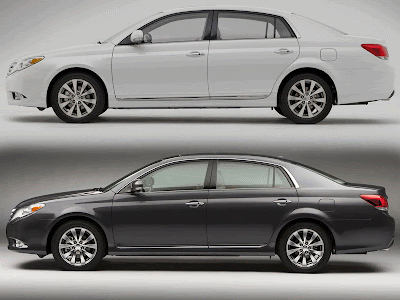
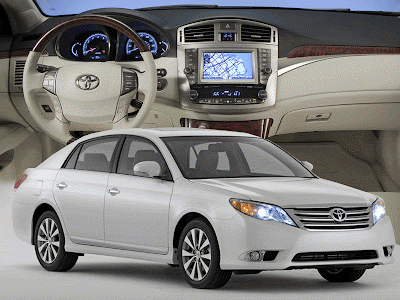
Evoking a time when travel was sophisticated, elegant and comfortable, the new Toyota Avalon possesses a distinctive new exterior style while offering a restyled interior rich with premium touch points and practical new technologies. Toyota introduced the boldly redesigned 2011 Toyota Avalon at the 2010 Chicago Auto Show. The third generation Toyota Avalon was introduced in four models: the standard XL, the sport Touring, the XLS, and the luxury Limited. Each combined generous interior room with powerful engine performance.
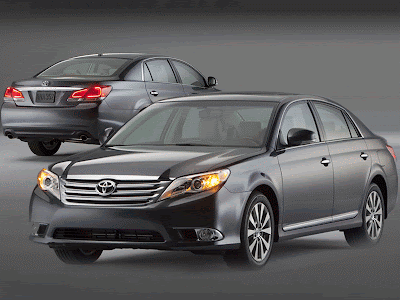
2011 Redesigned Toyota Avalon Third Generation
Designed at Toyota’s Calty Design Research in California, and assembled at Toyota’s Georgetown Kentucky manufacturing plant, the third-generation Avalons all have front grilles with horizontal chrome bars, large tail lamps, distinctive trunks, and dual exhaust outlets.
Even with numerous refinements inside and out, the Toyota Avalon remains true to the idea that comfort is honest and uncomplicated, and "Traveling Avalon Class" is rich in simple, familiar pleasures.

2011 Redesigned Toyota Avalon Third Generation
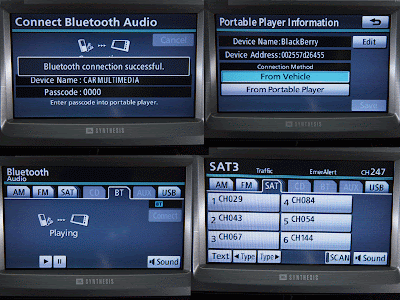
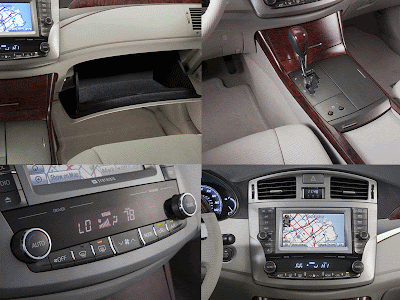
The new Toyota Avalon has dynamic and expressive lines, and an infusion of comfort, safety and technology advancements that enrich the driving experience. Upgraded equipment and technology features, such as a touch-screen navigation system with real-time traffic, and Bluetooth® hands-free phone capability with music streaming to the audio system are among the improvements that enhance the 2011 Avalon's excellent blend of spaciousness, comfort and technology.
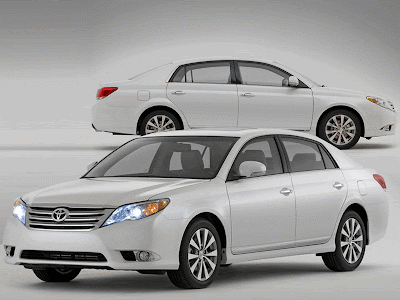
2011 Redesigned Toyota Avalon Third Generation
"The Toyota Avalon has long been appreciated by smart, conscientious consumers who recognize quality materials and the beauty of detailed craftsmanship," said Bob Carter, group vice president and general manager, Toyota Division, Toyota Motor Sales, U.S.A. "The changes made for 2011 will allow us to build on our position in the premium large car segment. The competition does not stand still, and neither do we."
2011 Redesigned Toyota Avalon Third Generation
Restyled at Calty Design Research in Newport Beach, Calif., the Toyota Avalon is assembled at Toyota Motor Manufacturing Kentucky (TMMK), a "zero landfill" facility that also assembles the Camry, Camry Hybrid, and Venza. It was also developed at the Toyota Technical Center (TTC) in Ann Arbor, Mich. For 2011, Calty restyled Toyota Avalon to project an elegant, outgoing presence. A wider, more substantial grille ties into state-of-the-art projector headlamps, working with a broad, undisturbed front hood to suggest a lowered center of gravity and emphasize the Toyota Avalon's wide stance.
2011 Redesigned Toyota Avalon Third Generation
A power rear sunshade, deployable via a one-touch lever, filters direct sunlight coming through the rear window. The sunshade, which helps to protect rear seat passengers from unwanted light and heat, automatically detracts when the driver selects reverse gear. Toyota Avalon's exceptional combination of ample horsepower and excellent fuel economy offers one of the best overall dynamic performances in the large sedan segment.
2011 Redesigned Toyota Avalon Third Generation
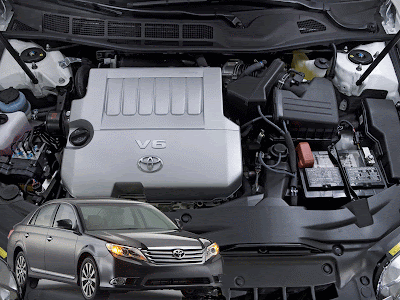
The 2011 Avalon is powered by a 24-valve, dual-overhead cam 3.5-liter V6 engine that produces 268 horsepower at 6,200 rpm. The engine is equipped with the latest dual VVT-i electronic valve-control mechanism that provides a broader powerband, while requiring less fuel and generating fewer emissions. It is mated to a multi-mode six-speed automatic transmission. The 2011 Toyota Avalon is an Ultra Low Emission Vehicle (ULEV), EPA-estimated to deliver 20 mpg in the city, 29 highway, and 23 combined, as good as or better than any V6 model in the segment.
2011 Redesigned Toyota Avalon Third Generation
The 2011 Toyota Avalon will be available in two grades when it arrives in showrooms in the spring of 2010, Avalon and Limited. Both grades will be well equipped with standard equipment like eight-way leather-trimmed power driver's seats, back-up camera, dual zone automatic climate control with air filtration, moonroof and 17-inch alloy wheels. Toyota Avalon will be available in nine exterior colors including three new colors: Zephyr Blue Metallic, Cypress Pearl and Sizzling Crimson Mica.

Labels: 2011, Sports Car, Sports Sedan, Toyota

Toyota Hybrid X concept car
Toyota will provide a vision for the future of hybrid cars when it unveils the Hybrid X concept car at this year’s Australian International Motor Show.
Hybrid X proposes a new design language for Toyota’s hybrid models while also acting as a technology showcase for future hybrid cars.
Created and developed by Toyota’s European styling centre ED² in the south of France, Hybrid X is a four-door, four-seat concept that is spacious and comfortable.It is a step closer to Toyota’s vision of the ultimate environmental driving technology.
Its design will influence the entire Toyota brand and its hybrid models in the future.A vision for future environmentally friendly motoring, the appearance of Hybrid X comes soon after Toyota announced it would build a hybrid Camry in Australia from 2010.
Hybrid X is the latest concept to demonstrate Toyota’s world-leading Hybrid Synergy Drive® technology, which is at the core of the company’s strategy to develop the ultimate eco-car.
The show car fits clearly within Toyota’s environmental strategy of offering sustainable mobility for modern families.
It has the dimensions of a conventional family car with an overall length of 4,500mm and wheelbase of 2,800mm. The width is 1,850mm and height 1,440mm.
It proposes unconventional creative solutions that will potentially become the signature points of a specific hybrid identity.
Hybrid X features a futuristic body shape that is dominated by two ‘U’ shapes created by the upper glass frame area and the unconventional A and C pillars.
Viewed from above, this gives the impression of a large X – hence the name of the concept, Hybrid X.
Dynamic hints of driving performance are provided by the customised 20-inch alloy wheels with ultra-low profile 225/40 R20 tyres.
LED headlamps are integrated into the dashboard and are now part of the interior of the car and can communicate information such as safety distances, acceleration and braking to other drivers and pedestrians.
The driver can set the ambience within the car, controlling sight, sound, touch and even smell.
A drive-by-wire steering pad features a central screen to relay information to the driver about the energy flow path, fuel consumption and gear position.
Space-saving seats are formed using injected foam techniques, which create comfort while reducing weight.
The two independent rear seats can swivel by 12 degrees to allow passengers to enjoy the scenery or conversation.
Hybrid X proposes a new design language for Toyota’s hybrid models while also acting as a technology showcase for future hybrid cars.
Created and developed by Toyota’s European styling centre ED² in the south of France, Hybrid X is a four-door, four-seat concept that is spacious and comfortable.It is a step closer to Toyota’s vision of the ultimate environmental driving technology.
Its design will influence the entire Toyota brand and its hybrid models in the future.A vision for future environmentally friendly motoring, the appearance of Hybrid X comes soon after Toyota announced it would build a hybrid Camry in Australia from 2010.
Hybrid X is the latest concept to demonstrate Toyota’s world-leading Hybrid Synergy Drive® technology, which is at the core of the company’s strategy to develop the ultimate eco-car.

Toyota Hybrid X concept car
The show car fits clearly within Toyota’s environmental strategy of offering sustainable mobility for modern families.
It has the dimensions of a conventional family car with an overall length of 4,500mm and wheelbase of 2,800mm. The width is 1,850mm and height 1,440mm.
It proposes unconventional creative solutions that will potentially become the signature points of a specific hybrid identity.
Hybrid X features a futuristic body shape that is dominated by two ‘U’ shapes created by the upper glass frame area and the unconventional A and C pillars.
Viewed from above, this gives the impression of a large X – hence the name of the concept, Hybrid X.
Dynamic hints of driving performance are provided by the customised 20-inch alloy wheels with ultra-low profile 225/40 R20 tyres.
LED headlamps are integrated into the dashboard and are now part of the interior of the car and can communicate information such as safety distances, acceleration and braking to other drivers and pedestrians.
The driver can set the ambience within the car, controlling sight, sound, touch and even smell.
A drive-by-wire steering pad features a central screen to relay information to the driver about the energy flow path, fuel consumption and gear position.
Space-saving seats are formed using injected foam techniques, which create comfort while reducing weight.
The two independent rear seats can swivel by 12 degrees to allow passengers to enjoy the scenery or conversation.
Labels: Concept Car, Hybrid Car, Toyota

Toyota FT-86 Concept definitely looks cool.
The concept car Toyota FT-86 (that’s hachi roku in Japanese) goes back to the fundamental qualities of the classic sports car with its rear-wheel drive configuration, compact dimensions, low centre of gravity and lightweight construction. Under the bonnet there is a 2.0-litre boxer engine that is strong on both performance and environmental quality
Great to own and fun-to-drive: those are the guiding principles behind a new Toyota sports car concept that will break cover for the first time at the Tokyo motor show later this month.
The show car’s bodywork is finished in Flash Red, an eye-catching shade that contains a hint of blue. Inside, the cabin design further expresses the car’s classic sporting qualities with many of the structural elements left uncovered.
Labels: Concept Car, Design Car, Sport Car, Toyota

Toyota PM Concept Car
Toyota PM is highly maneuverable thanks to its castor like wheels capable of rotating through 180 degrees. The front wheels are also notable because of their hub-less design.
The futuristic Toyota PM concept from 2003 is a personal transport concept.
The PM's cockpit opens by touching one of the unusual stalk mounted headlights, this then glows green to announce the impending opening of the glass canopy.
Another interesting feature Toyota has built into the PM is its adjustable ride height and attitude. As the PM's speed increases it lowers to the ground to increase stability and improve aerodynamics.
Inside the PM information regarding vehicle performance and the location of other PM's is relayed to the single occupant by a floating virtual display.
Power for the concept comes from an electric motor.
Labels: Concept Car, Design Car, Electric Car, Toyota
Subscribe to:
Posts (Atom)


